
Table of Contents
- 7 Warning Signs of Failing Garage Door Springs
- Garage Door Spring Life Expectancy: How Long Should Yours Last?
- Why Springs Fail Early in Indiana: Climate, Cycles, and Corrosion
- Torsion vs. Extension Springs: Which One Is on Your Door?
- DIY vs Professional Garage Door Spring Repair
- Garage Door Maintenance Tips Carmel IN: Extend Spring Life
- Emergency Safety Protocols When a Spring Breaks
- Frequently Asked Questions
Last Updated: September 14, 2026
7 Warning Signs of Failing Garage Door Springs
A garage door spring is the counterbalance component that carries most of the door’s weight, and when it fails, it usually gives you warning first. At Garage Door Pro in Carmel, Indiana, we’ve replaced thousands of springs since 2016, and the pattern is always the same: the door tells you something is wrong weeks before the spring snaps. Below, we’ll walk through the seven signs of failing garage door springs, what each one means, and when to stop using the door entirely.
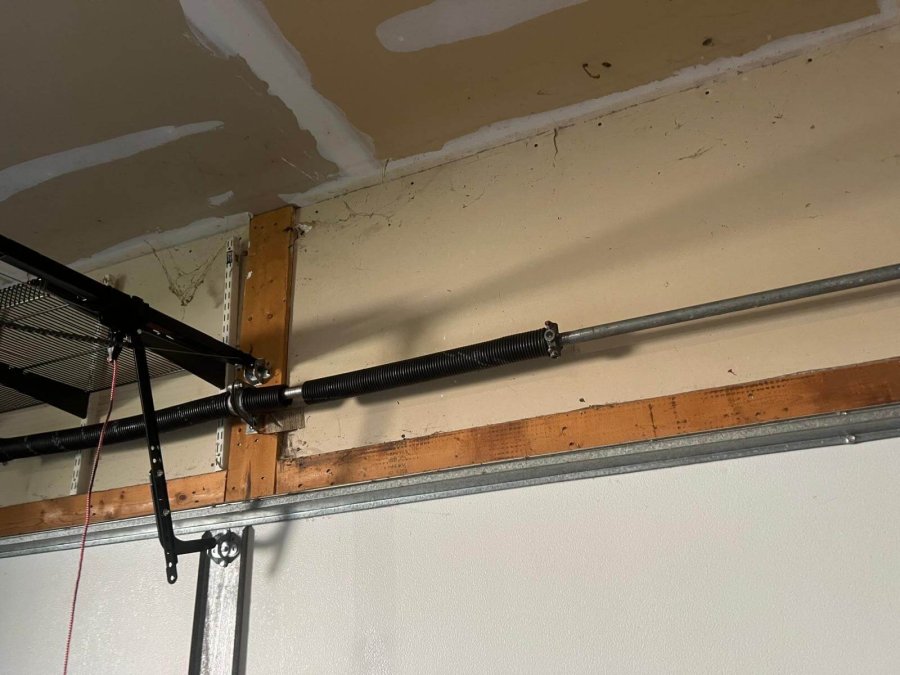
Close-up photograph of a garage door torsion spring mounted on the metal shaft above a closed door, showing a visible gap between the coils
Visible Gaps in the Spring Coils
A healthy torsion spring is a tight, uniform coil. A gap of an inch or more between windings means the spring has stretched past its working range and lost tension. Once that gap appears, the spring is running on borrowed time. The same applies to extension springs that look stretched or unevenly wound along their length.
Loud Bang or Snapping Noise From the Garage
That sudden bang you heard from the garage was likely the spring breaking, not something falling over. Torsion springs fail with a sound that carries through the whole house. If you heard it, stop operating the door and inspect before pressing the opener button again.
The Door Feels Heavy or Won’t Stay Open
A balanced door should lift with light resistance and hold at the halfway point when you disengage the opener. If it slams down, drifts, or feels like dead weight, the spring has stopped carrying its share of the load. The opener is now doing work it was never built to do.
Other signs to watch for:
- Door opens only a few inches and stops
- Door opens unevenly or crookedly, with one side lagging
- Visible cable fraying near the drums or bottom brackets
- The opener strains, hums, or trips its safety reverse for no clear reason
Garage Door Spring Life Expectancy: How Long Should Yours Last?
Most torsion springs are rated for 10,000 cycles, which works out to roughly seven to ten years for a typical household opening and closing the door three to four times a day. A cycle is one full open-and-close, so a busy family with teenagers coming and going can burn through that rating in half the time. If you want the real number for your door, do the math: four cycles a day times 365 days is 1,460 cycles a year. Divide 10,000 by 1,460 and you get about 6.8 years. A household that opens the door eight times a day hits 2,920 cycles a year and reaches 10,000 cycles in under three and a half years.
Cycle rating is not the only variable. Spring wire gauge and inside diameter are matched to the door’s weight and height. A standard 7-foot double door might use a 0.225-inch wire gauge spring, while a heavier insulated door or an 8-foot door needs a thicker wire or a larger inside diameter to carry the load. When a spring is undersized for the door, it runs at higher stress per cycle and fails early even if the cycle count is low. That is why a spring that lasted 12 years on one door might fail in five on another.
Two factors shorten that window faster than anything else: cycle count and corrosion. Springs in unheated garages see condensation through Indiana’s freeze-thaw swings, and rust pits the steel until it cracks. If your spring is past the seven-year mark and you’ve never had it inspected, book an inspection before it decides the timing for you.
Why Springs Fail Early in Indiana: Climate, Cycles, and Corrosion
Indiana’s climate is hard on garage door hardware. Metal fatigue accelerates when steel cycles between freezing winters and humid summers, and Carmel garages sit right in that pattern. Every spring contraction and expansion works the wire, and corrosion weakens it from the outside in.
What most guides miss is that lubrication matters more here than in drier states. A dry spring grinds against itself with every turn, and that friction adds stress cycles on top of the ones your door already logs. A light application of garage door lubricant on the coils twice a year, along with a visual check for rust, buys real time. For a full walkthrough of what to check and when, see the International Door Association maintenance guidance.
Torsion vs. Extension Springs: Which One Is on Your Door?
Before you can spot a failing spring, you need to know which type you have. Torsion springs mount horizontally on a metal shaft above the closed door and twist to store energy. Extension springs run along the horizontal tracks on each side and stretch instead. If you see a coiled spring above the door running parallel to the header, you have torsion springs. If you see springs stretching along the side tracks, you have extension springs.
Torsion springs have largely replaced extension springs in new installations for one main reason: safety. When a torsion spring breaks, the shaft and the stationary cones contain the pieces, so the break is usually a clean snap with the spring staying on the shaft. When an extension spring breaks, it can fly loose with enough force to damage a car or injure anyone standing nearby (dasma.com). That is why extension springs should always run inside safety cables that contain them when they break. If yours don’t have cables, that’s a problem worth fixing before anything else.
Feature | Torsion Springs | Extension Springs |
|---|---|---|
Location | Shaft above the door | Along side tracks |
How they work | Twist to store energy | Stretch to store energy |
Failure mode | Clean break, loud bang | Stretch, snap, fly loose |
Cycle life | 10,000 to 25,000+ cycles | 10,000 cycles typical |
Safety hardware | Shaft contains the break | Requires safety cables |
Repair approach | Replace as a matched pair | Replace both sides together |
Common in | Most homes built after 1990 | Older homes, some single-car doors |
A common pattern is that a door with two torsion springs will still open on one spring for a short time after the other breaks. That puts double the load on the remaining spring and the opener, and it usually leads to a second failure within days. If you have two springs and one has visibly failed, stop using the door until both are replaced.
DIY vs Professional Garage Door Spring Repair
DIY spring repair is one of the few home repairs where the honest answer is no. Winding a torsion spring means loading it with enough stored energy to lift a door that weighs hundreds of pounds, and the winding bars, cones, and tension calculations leave no margin for error. A spring that lets go mid-wind can cause serious injury.
Professional repair also gets you the right spring. Springs are matched to door weight, height, and track radius, and a mismatched gauge will fail early or overload the opener. Garage Door Pro stocks torsion springs on every truck and provides a fixed total cost before work begins, so a same-day repair usually means one visit rather than three.
Garage Door Maintenance Tips Carmel IN: Extend Spring Life
A short maintenance routine, done twice a year, is the cheapest way to get more years out of a spring. Here’s the checklist we use:
- Look for gaps in the coils and rust streaks on the wire
- Lubricate springs, rollers, hinges, and the opener rail
- Test the door’s balance with the opener disengaged
- Check cables for fraying near the drums and bottom brackets
- Tighten all hinge and bracket bolts
- Test the safety reverse with a block of wood
- Listen for new noises during a full open-and-close cycle
If a spring is already showing a gap or the door has lost balance, maintenance won’t reverse that. It’s a replacement, and it’s better scheduled than emergency.
Emergency Safety Protocols When a Spring Breaks
When a spring snaps, the priority is containing the door, not fixing it. Pull the manual release cord to disengage the opener, then leave the door closed and don’t force it up. The emergency disconnect keeps the opener from fighting a door it can’t lift.
Keep everyone, especially children, out of the garage until a technician arrives. A door held up by a single spring or by nothing at all can drop without warning. If the door is stuck open, don’t stand underneath it while you figure out what to do. Call for same-day service and keep the area clear.
A failing spring rarely fails without notice. Gaps in the coils, a door that feels heavy, and that unmistakable bang are all the door asking for help before it quits entirely. Garage Door Pro is a veteran-owned, BBB A+ accredited team serving Carmel, Westfield, Zionsville, Fishers, Noblesville, and the greater Indianapolis area, with 24/7 dispatch, same-day service, and a fixed total cost you approve before any work starts. We keep torsion and extension springs on every truck, handle the parts warranty directly, and service openers, cables, rollers, tracks, keypads, and safety sensors in the same visit. Get a free quote from Garage Door Pro and get your door running smoothly again.
Frequently Asked Questions
What is the average life expectancy of a garage door spring?
Most garage door springs are rated for 10,000 cycles, which typically translates to 7 to 10 years for an average household opening the door three to four times per day. High-cycle springs can last two to three times longer. In Indiana, humidity and temperature swings can shorten that lifespan, so annual inspections help you catch wear before a spring snaps.
Is it safe to operate a garage door with a broken spring?
No. A broken spring means the full weight of the door, often 150 to 300 pounds, is unsupported. The opener may try to lift it, but the strain can burn out the motor or cause the door to fall suddenly. Stop using the door, disconnect the opener, and call a professional for same-day service.
How can I tell if my garage door spring is broken?
Look for a visible gap in the coils, listen for a loud bang, and try lifting the door manually. If it feels extremely heavy or won’t stay open, the spring is likely broken. You may also see the door open a few inches and stop, or notice the cables have gone slack. Any of these signs means you should call a technician.
Why do garage door springs fail prematurely in Indiana?
Indiana’s humid summers and freezing winters accelerate corrosion and metal fatigue. Road salt tracked into the garage can also attack the steel. Springs that aren’t lubricated regularly rust faster, and a lack of balance causes uneven wear. Scheduling annual maintenance with a local Carmel company helps springs reach their full cycle life.