Table of Contents
- Why Hidden Garage Door Repair Fees Are So Common
- How to Spot Garage Door Repair Scams Before You Sign
- Questions to Ask Garage Door Repair Technicians Before Work Starts
- How to Read a Garage Door Repair Estimate Template
- Emergency vs. Non-Emergency Fees: What Changes After Hours
- Vetting Local Technicians in Carmel, Indiana
- Warranty Coverage and Preventative Maintenance That Avoid Future Fees
- Conclusion
- Frequently Asked Questions
Last Updated: September 12, 2026
Why Hidden Garage Door Repair Fees Are So Common
The garage door repair industry has a transparency problem. Avoiding hidden garage door repair fees starts with understanding why they exist: many companies advertise a low service call fee, then make up the difference through parts markup, overtime rates, and charges absent from the original quote.
Garage Door Pro launched in Carmel in 2016, focusing on garage door torsion spring replacement, repair, and high-cycle upgrades. We’ve watched this play out across Carmel and the greater Indianapolis area since then. A homeowner calls about a broken torsion spring, hears a reasonable number on the phone, then faces a bill hundreds of dollars higher once the truck arrives.
The pattern repeats because the incentives reward it. A dispatcher quotes a number designed to get the truck rolling. The technician, often working on commission, is expected to find additional work once on site. The FTC’s guidance on deceptive pricing and advertising is clear that bait-and-switch pricing can cross into illegal territory, which is why the Indiana Attorney General’s consumer protection resources exist to help homeowners push back.
Below, we’ll show you how to spot these fees before you sign, what to ask, and how to read an estimate line by line.
How to Spot Garage Door Repair Scams Before You Sign
Garage door repair scams follow a predictable script, and the warning signs appear before anyone touches your door. The tell is almost always pressure to commit before you have a written, itemized number.
Red Flags That Show Up Before the Truck Arrives
- A quote given over the phone without any questions about your door’s type, size, or spring system
- Refusal to put an estimate in writing before the visit
- A price that sounds dramatically lower than every other quote you received
- No verifiable local address, license, or business history
Red Flags That Show Up at Your Door
- The technician claims the quoted price only covered “the diagnostic” and the real repair costs more
- You’re told the door needs a full replacement when a single component failed
- Cash-only payment demands or pressure to decide on the spot
- No company name on the truck, the uniform, or the invoice
If a technician refuses to give you a written, itemized estimate before starting work, stop the conversation. Once parts are installed, your use to dispute the price drops to nearly zero.
Questions to Ask Garage Door Repair Technicians Before Work Starts
The right questions, asked before anyone picks up a tool, separate a straight quote from a padded one. Ask these and write down the answers:
- Is there a service call fee or diagnostic charge, and does it apply to the repair if I proceed?
- Can I get a fixed-price quote in writing before work begins?
- Is this an emergency or non-emergency rate, and does the price change after hours?
- Are parts included in the quote, or billed separately with markup?
- Is there a disposal fee for the old spring, cables, or hardware?
- What does the parts warranty cover, and who handles the claim?
- Are there any permit requirements for this repair in Carmel?
A company that answers all seven without hesitation is one you can work with. One that dodges even two is one to walk away from.
How to Read a Garage Door Repair Estimate Template
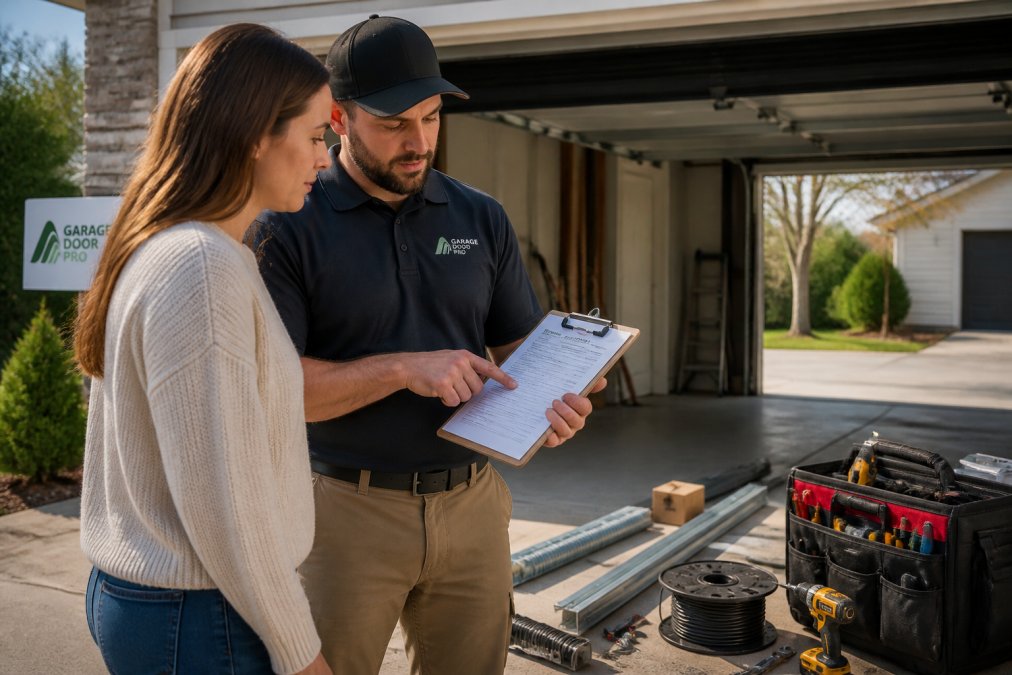
A garage door repair estimate template is only useful if every line tells you what you’re paying for. Most padded invoices hide their margin in vague descriptions like “labor and materials” or “shop supplies.”
What Every Line Item Should Tell You
| Line Item | What It Should State | Red Flag If Missing |
|---|---|---|
| Service call fee | Flat amount, stated upfront | “Varies” or blank |
| Diagnostic charge | Whether it’s credited to the repair | Never mentioned |
| Parts | Specific component name and quantity | “Misc. parts” |
| Labor | Hours or flat rate, not both | “Labor and materials” lumped |
| Disposal fee | Amount for hauling old hardware | Added after the fact |
| Permit requirements | Whether a permit is needed | Skipped entirely |
| Warranty | Parts and labor coverage terms | “As-is” or silent |
Ask the technician to write the total on the estimate and initial it. A fixed total cost, agreed before work starts, is the single best protection against a surprise bill.
Emergency vs. Non-Emergency Fees: What Changes After Hours
Emergency repairs almost always carry a premium, and that’s fair when a door is stuck open at midnight. The problem is companies that bill emergency rates for work that could have waited until morning. To avoid that premium, understand how after-hours pricing is structured and triage your situation before you dial.
How After-Hours Pricing Is Actually Structured
Many garage door companies build pricing around three windows:
- Standard business hours (typically Monday through Friday, roughly 8 a.m. to 5 p.m.): the base rate, with service call fee, diagnostic charge, parts, and labor billed at the published rate.
- Extended hours (weekday evenings and Saturday daytime): often a modest surcharge, sometimes waived if the company runs same-day dispatch as standard.
- After-hours and holidays (nights, Sundays, and major holidays): the highest tier, where an overtime labor rate is applied on top of the standard service call fee, plus a separate emergency dispatch charge.
The trap: some companies apply the after-hours tier to any call placed outside 9-to-5, even if the technician arrives the next morning. Ask: “Is the after-hours rate based on when I call, or when the technician arrives?” The answer should be the latter.
True Emergencies vs. Repairs That Can Wait Until Morning
A true emergency is a safety or security problem that cannot wait:
- A torsion spring has snapped and the door is stuck halfway open, leaving your home exposed overnight
- The door is stuck in the open position and cannot be manually lowered
- A cable has snapped and the door is hanging unevenly, creating a falling hazard
- The door came off its tracks and is blocking a vehicle you need for work or medical transport
These are not emergencies, even though they feel urgent:
- A door that won’t close because a safety sensor is misaligned or has a cobweb across the lens, this is often a two-minute fix you can do yourself
- A remote or keypad that stopped working, usually a battery or reprogramming issue
- A noisy door or one that runs slightly rough, a maintenance issue, not a safety issue
- A cosmetic dent or a single broken roller, schedule it for the next business day
Before you pay an after-hours premium, ask yourself one question: Can I secure the house tonight without a technician? If you can manually lower the door using the emergency release cord and lock it, you can almost always wait until morning and save the overtime tier.
How to Use the Emergency Release Cord Safely
If your door is stuck open and you want to avoid an after-hours call, the emergency release cord (the red handle on the trolley) disengages the door from the opener so you can lower it by hand. Pull it only when the door is fully closed or fully open, never mid-travel, because the door can drop suddenly. Once it’s down, engage the manual lock or place a vice grip on the vertical track above a roller to prevent the door from being lifted from outside.
What to Say When You Call
When you call after hours, lead with triage information so the dispatcher quotes the right tier:
- “The door is stuck [open/closed/halfway] and I [can/cannot] secure it tonight.”
- “Is the rate you’re quoting me the after-hours rate or the standard rate?”
- “If I schedule this for tomorrow morning instead, does the price change?”
- “Is the after-hours charge a flat fee or an hourly overtime rate?”
A straight company answers all four without hesitation. One that dodges question three wants you to commit before you’ve done the math.
At Garage Door Pro, our dispatch team operates 24/7 and offers same-day service as standard, so you don’t pay a premium just because you called in the evening. A technician provides a fixed total cost, and work only starts after your approval.
Vetting Local Technicians in Carmel, Indiana
Carmel homeowners have more leverage than they realize when choosing a technician, but only if they know what to verify. What protects you is confirming the company is licensed, insured, and accountable under Indiana law before anyone touches your door.
Step 1: Verify the Company Is Registered in Indiana
Indiana does not issue a statewide garage door contractor license (in.gov). Two checks matter:
- Indiana Secretary of State business registration. Search the company name at the Secretary of State’s business search to confirm it is a registered entity in good standing, not a shell name that changes every few months. A company that cannot be found in the state registry is a company you cannot hold accountable.
- Local Carmel and Hamilton County requirements. The City of Carmel and Hamilton County may require contractors performing certain work to hold local permits or registrations. Ask: “Do you pull permits when the job requires one, and can you show me your registration?” A legitimate local operator will have a straight answer.
Step 2: Confirm Insurance, and Ask for the Certificate
This is the step most homeowners skip, and the one that matters most if something goes wrong. A technician injured on your property, or who damages your door, car, or home, could become your liability if the company is uninsured.
Ask for two documents before work begins:
- General liability insurance certificate, covers property damage
- Workers’ compensation certificate, covers injuries to the technician on your property
A real company will email or text these within minutes. A company that says “we’re covered, don’t worry about it” is telling you they do not have the paperwork.
Step 3: Read Reviews the Right Way
Search the company name plus “reviews” and read the most recent ten. Look for patterns, not one-offs:
- Do multiple reviewers mention the final bill matching the quote?
- Do reviewers name the same technician repeatedly (a sign of a stable crew) or a rotating cast (a sign of subcontracting)?
- How does the company respond to negative reviews? A business that engages and resolves complaints is safer than one that ignores them.
For Carmel specifically, check the BBB profile for the Indianapolis region. Garage Door Pro holds an A+ BBB accreditation and is a veteran-owned business, both verifiable rather than claimed.
Step 4: Confirm the Service Area Is Real
For anyone searching for a garage door repair near me in Carmel, ask whether the company actually serves your area or just lists it. A company based an hour away may charge travel time you never agreed to, and may not return quickly if the repair fails. Ask: “How many technicians do you have based within 20 miles of Carmel?”
Step 5: Get the Written Fixed-Price Quote Before Anyone Arrives
This is the single most important step, and it separates a vetted company from a gamble. Ask for the quote in writing, text or email is fine, before the technician is dispatched. It should state the service call fee, the diagnostic charge, whether the diagnostic is credited to the repair, and a fixed total for the work described.
If a company will not put a fixed total in writing before the visit, no amount of positive reviews makes them safe to hire. The written quote is your only enforceable protection once parts are installed.
Vetting a Carmel technician is a ten-minute task: confirm the Indiana business registration, ask for the liability and workers’ comp certificates, read the last ten reviews for billing patterns, confirm a local technician base, and get a written fixed-price quote before dispatch. Skip any of these and you’re gambling on the invoice.
Warranty Coverage and Preventative Maintenance That Avoid Future Fees
The cheapest repair is the one you never need. Preventative maintenance catches the failures that become emergency calls, and a solid warranty means you’re not paying twice for the same part.
A preventative maintenance schedule should include door balance checks, hardware lubrication, safety sensor testing, and a visual inspection of the torsion spring and cables. These tasks take a technician less than an hour and prevent the most common causes of sudden failure.
Warranty coverage matters just as much. Ask whether the parts warranty is handled by the manufacturer or the installer, and whether labor is covered if the same part fails again. Garage Door Pro handles the parts warranty directly, so you’re not stuck navigating a manufacturer’s claims process alone.
Conclusion
Hidden fees thrive on urgency, and a broken garage door is nothing if not urgent. The fix is simple: demand a written, itemized estimate, ask the seven questions above, and choose a company that answers them without flinching.
Garage Door Pro is veteran-owned, holds an A+ BBB accreditation, and offers same-day service across Carmel, Westfield, Zionsville, Fishers, Noblesville, and the greater Indianapolis region. Our technicians provide a fixed total cost, work only starts after your approval, and we keep springs on every truck so most jobs are finished in a single visit.
Get started with Garage Door Pro and get a free quote with the total written down before anyone touches your door.
Frequently Asked Questions
What are the red flags of fake garage door repair services?
Watch for unsolicited door knockers claiming your springs are about to fail, cash-only payment demands, pressure to decide on the spot, and quotes given over the phone without anyone inspecting the door. Legitimate companies provide a written itemized estimate, accept normal payment methods, and let you review the numbers before any work begins. If a technician refuses to put the total in writing, walk away.
What should be included in a professional garage door repair estimate?
A complete estimate lists parts by name and quantity, labor as a separate line, any service call or diagnostic charge, disposal fees for old components, and the warranty terms on both parts and labor. It should also state whether the figure is a fixed total or an hourly estimate. Ask for the total in writing before approving work, and keep a copy for your records in case a dispute comes up later.
Why do some garage door companies provide low-ball phone quotes?
A phone quote costs nothing to give and is easy to inflate later. Some companies quote a low figure to get a truck to your address, then add charges for parts markup, emergency rates, or issues they claim to discover on site. A fixed total after an in-person inspection is more reliable. If the final bill exceeds the phone number, ask for an itemized breakdown of every added charge.
How can I verify a garage door repair company’s reputation in Carmel?
Check the Better Business Bureau for accreditation and complaint history, read recent Google reviews rather than only the star average, and confirm the company has a real local address and Indiana registration. Ask neighbors and local community groups who they have used. A company with a long local presence, verifiable reviews, and a willingness to provide references is a safer bet than one you only know from a flyer.
How do I know if a garage door repair price is fair?
Fair pricing comes from a written estimate that separates parts, labor, and any service call fee, not from a single lump sum quoted over the phone. Get the scope in writing, ask what is and is not covered, and compare the line items against the work described. If a technician cannot explain why a charge exists, that charge deserves scrutiny before you approve anything.
Can preventative maintenance really reduce future repair fees?
Yes. Lubricating hardware, checking door balance, testing safety sensors, and inspecting cables and rollers on a set schedule catch small problems before they become spring or opener failures. Preventative care also keeps the door moving evenly, which reduces wear on the torsion spring and motor. A maintenance schedule is typically far less disruptive than an emergency repair call at night.